
Lewisburg Criminal History Checks
Begin with the type of fact you need. Buffalo Valley Regional Police Department, or BVRPD, holds reports tied to police calls and investigations in Lewisburg. The Magisterial District Judge and Union County Clerk of Courts hold the public court trail. Union County Jail is the direct source for current local custody because no official public jail roster was found. The UJS Portal and PATCH provide different statewide views, so a result from one cannot stand in for all the others.
- Ask BVRPD for the identified police or incident record, using the date, place, parties, and incident number when known.
- Search the UJS Portal under Magisterial District Court or Court of Common Pleas and narrow the county to Union.
- Call Union County Jail at (570) 524-8711 when the question is current local custody or booking.
- Request paper or certified court material from MDJ 17-03-01 or the Clerk of Courts after locating the docket.
- Use PATCH only when a Pennsylvania repository record check is the product needed.
Keep the source name with every result. A BVRPD report can describe facts that never produce a filed case. A booking entry records intake allegations. A court docket can later show withdrawn charges, dismissal, a plea, acquittal, or conviction. PATCH compiles reportable information received by the Pennsylvania State Police Central Repository and may update on a different schedule.
Lewisburg Police Records Are Regional
Lewisburg has not had a standalone borough police records office since its service consolidated with East Buffalo Township. BVRPD became the police agency on February 6, 2012. Its office is at 1610 Industrial Boulevard, Suite 500, Lewisburg, PA 17837. The office phone is (570) 524-4302, the fax is (570) 524-4128, and scanned forms may be sent to office@bvrpd.org.
This arrangement matters during a record search. A request addressed merely to “Lewisburg Police” can miss the actual custodian. It also affects statistics. BVRPD monthly and year-end reports cover regional agency activity unless a table expressly separates Lewisburg. The 2024 account described the funding split as 52 percent East Buffalo and 48 percent Lewisburg, which is another clear sign that agency totals should not be relabeled as borough-only figures.
The borough’s own public site gives useful local context. The official Lewisburg Borough page is also the source of the assigned borough visual.
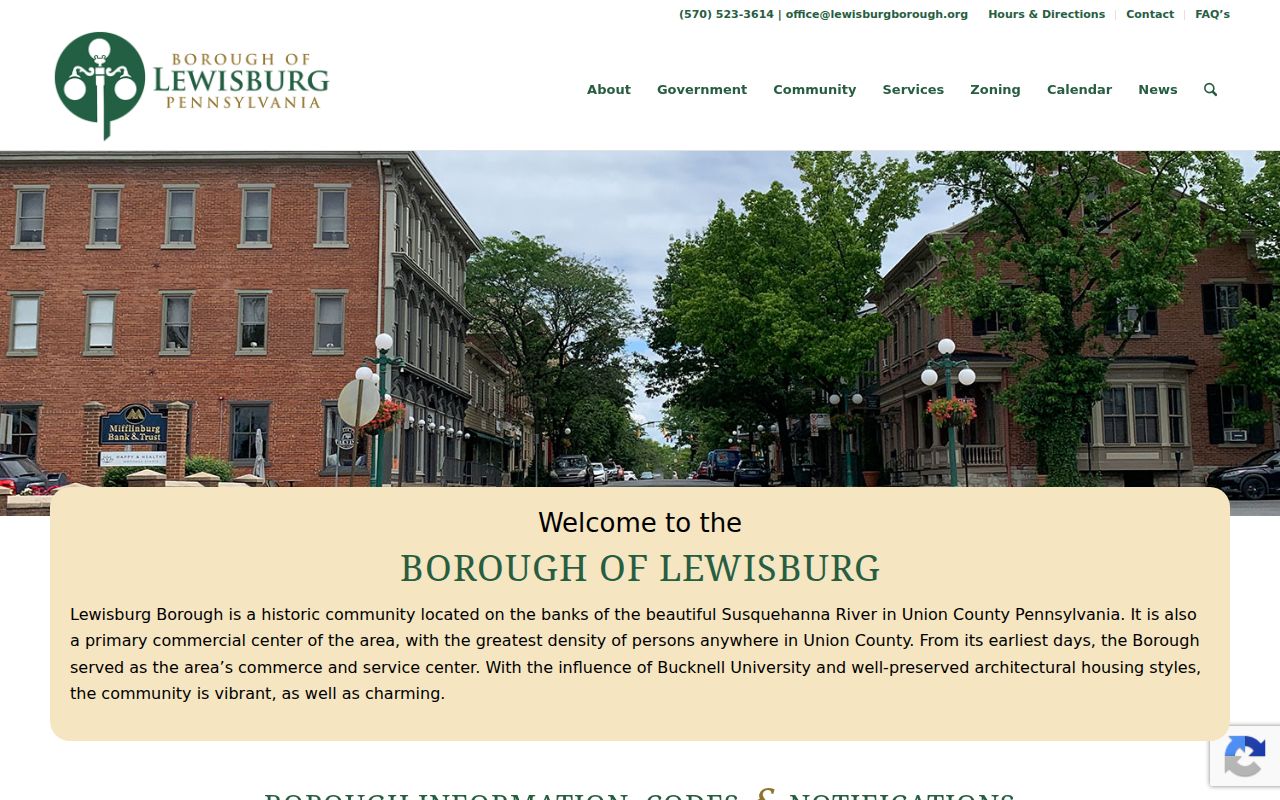
The borough source helps distinguish municipal administration from BVRPD police records and the county offices on South Second Street.
Records at the Lewisburg Police Department
BVRPD’s forms hub includes a Right-to-Know request and a local Request for Criminal Record Check. Forms can be delivered at the office, mailed, or sent as a scanned email. The accessible research did not establish the local check form’s fee or every field, so a requester should confirm those points with BVRPD instead of assuming PATCH pricing or fields apply.
The BVRPD Right-to-Know form asks for the requester’s contact details, submission and preferred response methods, and a narrative identifying the subject, time span, record type, and involved parties. It also offers electronic copies, printed copies, inspection, and certified-copy choices. A fee threshold lets the agency know when to seek approval before costs rise. Phrase the request as a request for an existing record, not as a question that asks staff to research or explain an event.
Not all police material is public. Criminal investigative information, protected victim or witness details, juvenile material, medical data, and personal identifiers may be withheld or redacted. A denial should state its legal basis and appeal route. The police report is also not the place to order the full filed court case.
Three Lewisburg Record Stops
Lewisburg’s records geography is unusually compact but still split among three custodians. Knowing the split saves calls and makes each request more precise.
| Lewisburg stop | Records to seek | Contact route |
|---|---|---|
| BVRPD, 1610 Industrial Boulevard | Police incident, arrest, and releasable agency records | (570) 524-4302 or office@bvrpd.org |
| 103 South Second Street | MDJ dockets, Common Pleas cases, and local custody | MDJ, Clerk of Courts, or jail office |
| Borough office, 55 South Fifth Street | Lewisburg municipal administrative records | (570) 523-3614 ext. 303 |
The South Second Street address houses several county functions, but they do not share one records counter. MDJ 17-03-01 can address its paper docket. The Clerk of Courts holds Common Pleas criminal files. Jail staff answer current custody questions. Give each office the docket, incident number, or exact record type that fits its role.
Booking and Arrest Records in Lewisburg
A BVRPD arrest may lead to intake in the Union County detention system, but Lewisburg does not advertise a borough lockup or public arrest database. For immediate custody, call Union County Jail at (570) 524-8711. Confirm custody rather than assuming every person arrested in the borough remains at the county jail. Transfers, release, bail, and placement outside the county can change where someone is held.
The police record and booking record answer different questions. BVRPD records the law-enforcement event. Jail intake can capture identity, fingerprints, a photograph, intake charges, property, bail, and custody details. Those charges are allegations at that point. Once a complaint reaches the court, the UJS docket is the better place to track charge changes and outcomes. The full county booking fallback is covered in the Union County arrest search.
Lewisburg Reports Are Not Blotters
BVRPD publishes monthly activity reports and an archive of year-end reports, but these are aggregate management records. They do not provide a name-based arrest blotter. A monthly count may mix calls, citations, incidents, or other work across the regional service area. It should not be used to claim that a named person was arrested or that all activity occurred within Lewisburg.
For a specific event, ask BVRPD for the releasable report and search UJS after a complaint is filed. For broader trends, select the exact period and read the table labels before comparing years. Pennsylvania’s Uniform Crime Reporting program can supply an official agency-level comparison, but the agency filter and reporting period must match. Regional figures and borough figures are not interchangeable.
The Lewisburg Municipal Court File
Pennsylvania boroughs do not use a separate municipal court in the way some states do. Lewisburg matters begin at Magisterial District Court 17-03-01, located at 103 South Second Street, Lewisburg, with telephone (570) 524-8656. That court serves Lewisburg, East Buffalo, Kelly, and Union townships. It handles traffic and nontraffic summary cases, preliminary arraignments and hearings, bail, and warrants.
| Court name | Magisterial District Court 17-03-01 |
|---|---|
| Lewisburg case types | Traffic and nontraffic summary cases, preliminary proceedings, bail, and warrant events |
| Online lookup | Free UJS Portal search by participant, docket, incident or complaint number, or organization |
| Docket fields | Status, filing dates, charges and grades, bail, events, hearings, and charge-level dispositions |
| Paper copies | Request from the MDJ for lower-court papers or the Clerk of Courts for Common Pleas material; confirm fees first |
A serious misdemeanor or felony that proceeds moves to the Union County Court of Common Pleas. The Clerk of Courts at the same street address keeps that file and can provide paper or certified material after the requester identifies the docket and document. Filed charges are not the same as convictions.
Lewisburg Dockets Versus Local Checks
A UJS docket is organized around a court case. It can show the complaint route, judge, counsel, charges, bail, hearings, sentence, and separate outcome for each count. BVRPD’s local criminal-record-check product comes from the police agency and has a different scope. Neither should be described as the other.
When the aim is to understand a known prosecution, search the UJS Portal and then request the pertinent court paper. When the aim is a police-held local record, contact BVRPD. PATCH is the Pennsylvania State Police repository product. Matching more than one non-sensitive identifier helps avoid confusing people with similar names. Always read the disposition column because a case may contain both dismissed and convicted counts.
How Lewisburg Records Reach the County
A local event can create several records at different times. BVRPD produces the incident or arrest report. If there is custodial intake, the county jail creates a booking record. MDJ 17-03-01 handles the early court stage. A case that advances can be filed in Common Pleas, where prosecutors may add, amend, withdraw, or dismiss charges. Courts and justice agencies then report eligible dispositions to the PSP Central Repository.
Record flow: Buffalo Valley Regional Police Department › Union County Courts › Pennsylvania State Police Central Repository
That sequence explains why a new police event may not appear in UJS or PATCH at once. It also explains why booking allegations may differ from the final docket. Search the newest local source for a recent event, then use the court record to determine what was filed and how it ended.
Lewisburg Records After 2012
The 2012 consolidation is the key date for modern police-record custody. Older references to borough policing can send a requester to the wrong name, while current police records belong with BVRPD. Lewisburg itself has a much longer civic record: settlement began as Derrstown in 1769, the street plan dates to 1785, borough incorporation came in 1822, and Lewisburg became the county seat in 1856.
Those dates have practical value for historical research. Modern criminal dockets belong in today’s UJS and court offices, while civic or archival questions may call for borough or historical collections. The historic district’s 646 buildings, dating from 1773 through 1910, are not evidence about modern crime. They simply show why a record request must define both the time period and the custodian.
Lewisburg Historic Records Need Dates
Lewisburg’s historic district contains 646 buildings dating from 1773 through 1910. That long span makes a date range essential in any historical request. Modern UJS searches and BVRPD records are the wrong tools for a nineteenth-century borough question. A researcher should state the old name, address, person, and event as precisely as the source permits.
Modern criminal records still follow today’s custodians. The historic count does not describe police cases, and a civic archive does not replace a current docket. Separating historical research from a present criminal-record check keeps the request focused and prevents local architectural facts from being misread as public-safety claims.
Lewisburg Record Access Rules
Police, court, booking, and repository records follow different access laws. The Pennsylvania Right-to-Know Law supplies a request and appeal process for local executive agencies, but it does not override criminal-investigation exemptions or confidentiality laws. Judicial records use court access policies. CHRIA governs collection, accuracy, dissemination, and relief for criminal-history information.
Key Statutes:
Pennsylvania Right-to-Know Law, 65 P.S. §§ 67.101 et seq. creates the local-agency request and appeal framework while preserving exemptions.
Criminal History Record Information Act, 18 Pa.C.S. Chapter 91 controls criminal-history collection, use, dissemination, and expungement.
Pennsylvania Rules of Judicial Administration 509 and 510 govern access to court records instead of the local RTKL process.
Protected identifiers, juvenile information, victim data, investigative material, sealed records, expunged records, and limited-access records may be missing or redacted. A public docket does not include every filed exhibit. When a record looks incomplete, ask the originating office about its scope before drawing a conclusion.